Detecting Competitor Spam: Protecting Your Map Rank From Sabotage
A local cafe owner called me at midnight because a competitor had dropped twenty 1-star reviews in an hour using a VPN. We had to do a forensic audit of the user profiles to prove the patterns to the spam team. I stood on the sidewalk outside that cafe; the air smelled like wet concrete after a summer storm. I looked at the digital storefront and saw the glitch. The reviews were not just mean; they were mathematically impossible. The users had no history in this zip code. Their GPS signals were non-existent. This was not a customer complaint; it was a tactical strike. In the world of high-stakes local search, your map pin is a target. If you are ranking in the top three, someone is likely trying to knock you off. It is not always through better SEO. Sometimes, it is through the dark arts of map sabotage.
The midnight call that exposed the review farm
Review spam is a coordinated attack on your reputation that requires a forensic response to neutralize the damage. Identifying these patterns involves looking at the account age of the reviewers and their geographic history. Most coordinated attacks use accounts with zero previous activity or accounts that have reviewed businesses in five different states within the same hour. When you see a sudden influx of negativity, do not panic. Document the timing. Capture the user IDs. You should look for fighting back against fake 1-star reviews from local competitors strategies to build a case for Google. The algorithm looks for sentiment clusters; if twenty people use the same unique phrasing about a ‘rude manager,’ it flags a pattern. This is where reputation management and review repair services become essential for restoring the trust signals that the map pack demands.
“Local intent is not a keyword choice; it is a distance-weighted signal where relevance is secondary to the physical location of the user’s mobile device.” – Map Search Fundamental
Why your physical coordinates are under constant attack
GPS coordinate salience is the mathematical foundation of your local ranking and the primary target for competitors. The algorithm calculates a centroid for every search query. If a competitor moves their pin closer to that centroid, even by a few hundred feet, they can leapfrog you. I have seen businesses ‘drift’ on the map because of malicious user edits. A competitor suggests an edit to your location, moving it to a back alley or a non-existent suite. If you are not monitoring your profile, that edit can be auto-accepted. This effectively kills your proximity signal. To combat this, you need monitoring competitor edits protocols. You must verify your pin daily. The distance between your verified address and the user is a hard limit. If the algorithm thinks you are in the wrong place, you disappear. This is why the only tools we use to audit google business profiles focus heavily on coordinate accuracy and history.
Local Authority Reading List
- How to Report Keyword Stuffing in Your Area
- Defending Your Rank Against Fake Reviews
- Stopping Competitor Map Sabotage Before It Sticks
- Pro Tools for Local Profile Auditing
The math behind the three mile radius
Proximity is a distance-weighted signal that shifts based on the density of businesses in your specific category. In a dense urban area, your ‘reach’ might only be 1.5 miles. In a rural setting, it might be 15 miles. Competitors exploit this by creating ‘ghost’ listings in neighboring zip codes. These are fake offices, often using coworking spaces or residential addresses, designed to intercept traffic before it reaches your legitimate business. This is map-spam in its purest form. If you notice a sudden drop in calls, check the map for new, suspicious entries. These businesses usually have no real photos of a storefront. They use stock images or pictures of the building exterior from Street View. You must use reporting keyword stuffing tools to flag these violations. When Google removes a spam listing, the local proximity vacuum is filled by the closest legitimate business. That should be you.
How to identify keyword stuffing in the wild
Business name manipulation is the most common way competitors cheat the map pack by adding geographic modifiers. If a business is legally ‘Smith Plumbing’ but they change their GMB name to ‘Smith Plumbing Best Plumber in Chicago,’ they are violating terms of service. This gives them an unfair advantage in the ranking weights for those specific terms. It is annoying to see a lower-quality service rank higher just because they broke the rules. You need gmb spam fighting and review cleanup services to systematically report these entities. The algorithm is getting better at detecting this, but manual reports still move the needle faster. I often find that these same businesses also use cleaning up toxic backlinks as a cover for their own aggressive link building strategies. They build thousands of low-quality links to their GMB profile, hoping to overwhelm the trust signal. It works until the manual review happens.
The forensic trace of service area polygons
Service area businesses must define their boundaries with precision to avoid triggering the Google overlap filter. When two businesses in the same category have identical service area polygons, Google often hides one. Competitors know this. They will sometimes expand their service area to perfectly overlap yours, effectively ‘filtering’ your business out of the search results. This is a subtle form of sabotage that most owners never notice. They just see their impressions drop. To fix this, you need local seo services to stabilize volatile map rankings after expansion. You should adjust your service area to be unique. Use zip codes instead of a giant radius. This creates a sharper signal for the algorithm. It is about the physics of the map. Every coordinate matters. Every pixel on that map represents a potential customer, and the competition is trying to steal your pixels.
Cleaning up the toxic link environment
Backlink sabotage occurs when a competitor points thousands of adult or gambling links at your local website. The goal is to trigger a manual action or a significant drop in trust. If your site was ranking perfectly and suddenly moved to page ten, check your Search Console. If you see thousands of new links from foreign domains, you are under attack. You need services to clean up spammy backlinks immediately. This is not about just disavowing. It is about proving to Google that you were the victim of a negative SEO strike. I have helped businesses recover by documenting the timeline of the link injection and presenting a clean-up report. It is a slow process, but it is the only way to save a deranked website. You also need to look for services to fix over optimized anchor text because the attack often targets specific keywords to make your site look like it is spamming the index.
“Local search is a spatial database problem, not a content problem; the trust is in the consistency of the data across the physical and digital world.” – Spatial Intelligence Group
The toolkit for local search dominance
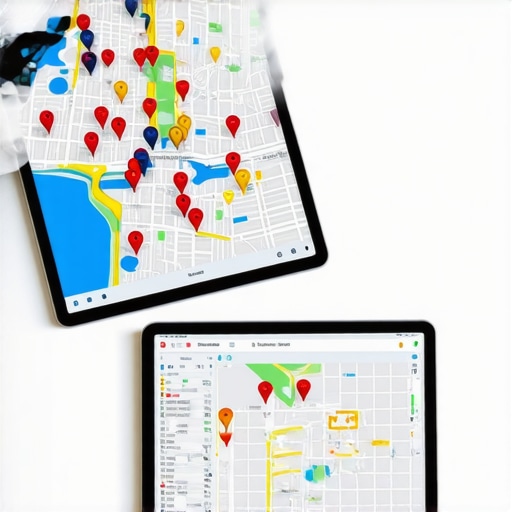
Professional local SEO requires a stack of tools designed specifically for map-based data rather than general web search. You cannot win this game with generic tools. You need a local seo checklist and toolkit for gmb that includes rank trackers with zip-code level precision. General rank trackers will show you are #1 in the city, but a local-specific tool will show you are #8 two blocks away. This granular data is where the battle is won. You should download gmb ranking tools for local seo that allow for heat-map visualizations. When you see a ‘dead zone’ in your ranking, that is where you focus your defensive efforts. Perhaps there is a spam listing there, or perhaps your citation consistency is weak in that specific neighborhood. Use the best local seo tools for google business profile to find the gaps before your competitors do.
Why anchor text is the silent killer of map rank
Over-optimization of anchor text creates a footprint that makes your business look like a low-quality lead generation site. If 80 percent of your links say ‘Best Plumber Chicago,’ you are going to get flagged. The algorithm wants to see natural brand mentions. Competitors sometimes ‘help’ you get flagged by building these exact-match links for you. It is a clever way to sabotage a rival. You need seo services to fix deranked website issues that focus on diversifying your link profile. Move your anchors toward your brand name and your URL. This builds a shield. It makes it harder for malicious links to tip the scales against you. You also need seo services to fix keyword stuffing and content issues on your actual landing pages. If your website looks like spam, Google will not trust your map pin.