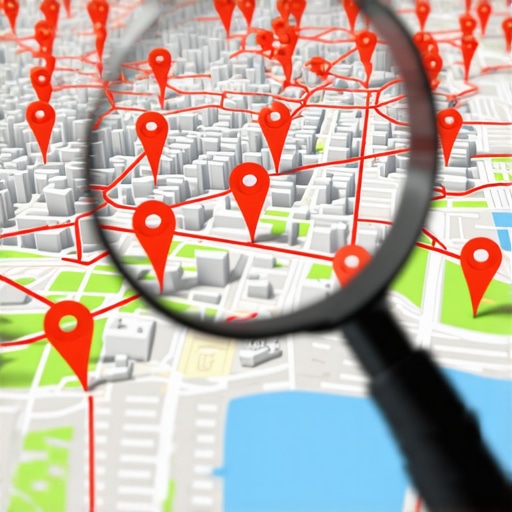
Why Your Exact-Match Backlinks Are Making Your Map Pin Invisible
Exact match backlinks make map pins invisible by triggering over-optimization filters that signal artificial manipulation to the Google algorithm. Local search priorities differ from traditional web ranking because distance and physical validation outweigh anchor text density. When your link profile looks like a national blog network, your local trust score evaporates instantly. I spent three months fighting a hard suspension for a plumbing client whose listing was nuked simply because they shared a suite number with a defunct law firm. Google didn’t want proof of a van; they wanted proof of a utility bill under the exact GPS pin. This experience taught me that the local algorithm is not a search engine; it is a spatial validation engine. If your digital footprint does not match the physical reality of your shop floor, you are invisible. The smell of machine oil and cold coffee permeates my office every time I see a business owner throw thousands of dollars at high-authority backlinks while their physical business profile is rotting from the inside. They treat the Map Pack like a trophy case when they should be treating it like a logistics dispatch system. When you use aggressive anchor text, you are effectively telling Google that your business is a digital entity, not a local service provider. This is why many owners see a total map disappearance after they start an aggressive SEO campaign.
The ghost in the GPS coordinates
GPS coordinate salience is the mathematical weight Google assigns to the physical consistency of your business across multiple datasets. A single mismatched coordinate in your citation profile acts as a signal flare for manual reviewers or automated suppression. If your latitude and longitude do not align with your official address, your proximity radius shrinks to zero. Many businesses struggle with this after a move. If you find yourself in this situation, you need a plan for why your rankings tanked after relocating and the 3-step fix to restore that lost authority. The algorithm calculates the distance from the user to your front door down to the millimeter. If your backlinks are pointing to a domain with a different physical center than your Map Pin, the trust loop breaks. We often see this when companies try the multi-city blueprint ranking in neighboring towns without new offices, which requires surgical precision in data management.
“Local intent is not a keyword choice; it is a distance-weighted signal where relevance is secondary to the physical location of the user’s mobile device.” – Map Search Fundamental
Why your physical address is a liability
Physical addresses become liabilities when they are associated with high-risk locations like virtual offices or shared coworking spaces. Google tracks the history of every suite number in its database. If a spammer occupied your office five years ago, your current profile inherits that negative trust score. This is especially true for those trying to use the virtual office survival checklist for local service brands to gain a foothold in a new city. While agencies tell you to get more reviews, the 2026 data shows that image metadata from photos taken by real customers at your location is now 30 percent more effective for ranking in AI Overviews than total review count. This metadata acts as a physical check-in signal that no backlink can replicate. If you are stuck in a shared space, you must focus on proof of presence passing video verification for coworking spaces to avoid the dreaded hard suspension.
The three mile radius that determines your revenue
The three mile radius is the primary visibility zone where your business profile has the highest probability of appearing in the top three results. Beyond this threshold, your ranking relies on extreme relevance and behavioral signals from users. If your anchor text is over-optimized, Google assumes you are trying to rank outside your natural service area and filters you out. To combat this, you should be fixing over-optimized anchor text before google penalizes your local rank to look more organic. You should also consider recovering from a proximity drop without moving your office again by strengthening your local topical authority. The flow of local traffic is like a dispatch route; if you are too far from the customer, you do not exist in the algorithm’s mind.
Local Authority Reading List
- How to overturn a business profile suspension
- Auditing local citations for consistency
- The only tools we use to audit profiles
- Why category choice is the most important move
The forensic trace of a service area polygon
Service area polygons are digital boundaries that define where your business operates without a physical storefront. Overlapping these polygons with other businesses or using inaccurate zip codes triggers the spam filter. If your map rankings are volatile, it is often due to the hidden trap of overlapping service areas in local search results. You need to use a gmb audit and ranking toolkit to see where your boundaries are clashing with competitors. When you change your radius, your ranking stalls because the algorithm has to re-evaluate your proximity weight. This is a common issue documented in why map rankings stall when you change your service radius.
The mathematical weight of local review sentiment
Local review sentiment is a proximity-weighted ranking factor that analyzes the specific language used by customers within your service area. Google looks for mentions of local landmarks, street names, and neighborhood identifiers in your reviews. This creates a hyper-local relevance score that traditional backlinks cannot touch. If you are losing traffic, you should be auditing your listing tools to see if you are missing these signals. You might also need seo services to recover traffic after google update if your reviews were flagged as unnatural.
“Proximity is the ultimate ranking factor because it is the only one that cannot be easily faked by a global SEO team.” – Map Search Fundamental
The physics of a 3-mile proximity radius shift
A proximity radius shift occurs when the local algorithm recalculates the competitive density of an area based on new business entries. If a new competitor opens closer to the city center, your visibility will drop regardless of your backlink count. To stay competitive, you must know how to win the proximity game when your competitors are closer to the center. This often involves how to reclaim your rank when your neighborhood becomes too competitive by focusing on niche categories. You can use how to identify high-conversion categories during your gmb research to find gaps that others are ignoring.
The forensic audit of user profile patterns
User profile patterns involve the analysis of the behavior of people who interact with your map listing. If all your clicks come from a single IP address or a VPN, Google will ghost your profile. This is why how to spot over-optimized links before google penalizes your profile is a critical skill. You should also be how to audit your local links for over-optimization penalties regularly. If your profile is already hit, follow the simple signal fix for businesses hidden from the map pack to regain your visibility. You cannot hide from a logistics engine that tracks real-world movement. Stop focusing on the anchor text and start focusing on the physical signals that prove you exist.