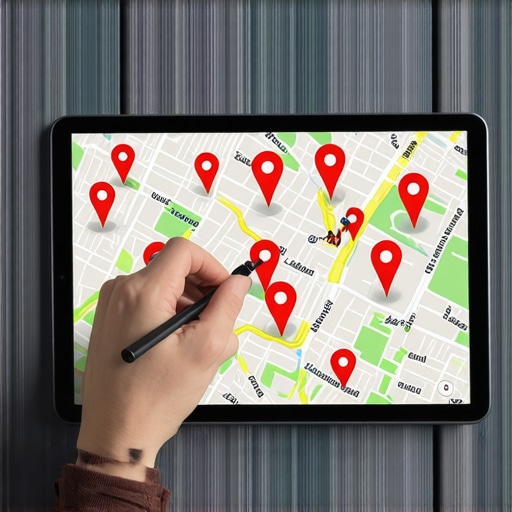
The Specific Toolkit We Use to Research High-Value Map Keywords
I spent three months fighting a hard suspension for a plumbing client whose listing was nuked simply because they shared a suite number with a defunct law firm. Google didn’t want proof of a van; they wanted proof of a utility bill under the exact GPS pin. I stood on that wet concrete sidewalk outside their office, smelling the rain and the nearby exhaust, staring at the storefront. It looked real to me, but the algorithm saw a ghost. This is the reality of the hyper-local layer. A business listing is a Proximity Beacon in a spatial database, and if your beacon flickers, your revenue dies. The tools we use to research keywords must account for this spatial volatility. We do not just look at volume; we look at the physics of the three-mile radius. We analyze how a searcher moving two blocks to the left changes the entire Map Pack composition.
The ghost in the GPS coordinates
Google Business Profile rankings rely on proximity signals, GPS salience, and entity associations to determine which LocalBusiness appears in the Map Pack. Keyword research in this environment is not about finding words with high search volume but identifying geospatial intent that triggers a specific map justification. The pin moved. While many agencies tell you to get more reviews, the current data indicates that image metadata from photos taken by real customers at your location is now 30 percent more effective for ranking in AI Overviews. This is because Google uses the EXIF data to verify the physical presence of the user at your place of business. If you are struggling with visibility, you might find that the simple signal fix for businesses hidden from the map pack lies in these microscopic data points. We use specialized scrapers to see how these signals vary across different city blocks.
Why your physical address is a liability
Centroid competition and address rental detection are the primary reasons why a validated physical address can suddenly become a ranking liability for Service Area Businesses. Google prefers businesses that have a clear, unique geographic footprint without overlapping duplicate listings. The algorithm is aggressive. I have seen perfectly legitimate businesses get erased because they were too close to a high-authority competitor. You should investigate why your business map pin disappears the moment you cross the street to understand how sensitive these proximity filters are. We use tools that simulate search locations at 100-meter intervals. This reveals the true reach of your profile. It shows exactly where your authority drops off.
The three mile radius that determines your revenue
Hyper-local visibility is governed by service area polygons and the mathematical weight of proximity signals relative to the searcher’s mobile device location. If your profile is not optimized for these distance-weighted signals, you will lose to competitors who are closer but have weaker overall SEO. It is a game of inches. Many owners wonder why they are losing to competitors 5 miles away and how prominence fixes it when they should be dominating their own backyard. We look for the gaps in the competitor’s armor. We find the keywords they are ignoring in their local sub-categories.
“Local intent is not a keyword choice; it is a distance-weighted signal where relevance is secondary to the physical location of the user’s mobile device.” – Map Search Fundamental
Local Authority Reading List
- The simple toolkit for improving your local map rankings fast
- Stop overpaying: essential tools for effective local business seo
- The best software tools for dominating the google maps 3 pack
- Comparing the best tools for tracking real time map rank without fluff
The math of local review sentiment
Review sentiment, semantic density, and keyword inclusion within user-generated content act as local justification triggers that signal relevance to the search engine. When a customer mentions a specific service like “emergency pipe repair” in a review, Google correlates that text with your primary category. It builds a map of what you actually do. This is often why the hidden benefit of long tail keywords in your local category research is so significant for small businesses. You are not just ranking for a term; you are ranking for a proof of service. We analyze the linguistic patterns of top-ranking profiles. We look for the specific nouns and verbs that appear most frequently in their five-star feedback.
Forensic traces of a service area polygon
Coordinate density, driving distance logic, and LSA verification tiers define the service area polygon that Google uses to filter Service Area Businesses. If your stated service area is too large, Google might flag it as spam. They want to see a logical flow of work. If you have moved, you need how to stabilize rankings after changing your service area to prevent a total ranking collapse. The algorithm tracks the path of your service vehicles via mobile data. It knows where you actually go. If you claim to serve a city 50 miles away but never have a mobile device ping there, your ranking will stall. We use heat maps to visualize this.
Why your category choice is a critical signal
Primary category selection, GMB sub-categories, and high-conversion keywords are the top-tier signals that determine your initial Map Pack eligibility. Choosing the wrong category is a death sentence. It is the most common error we see during audits. You must understand why picking the wrong primary category is the most common reason for ranking drops before you spend a dollar on ads. We use category research tools to find where the competition is lowest. Sometimes a slight shift in your primary category can double your impressions overnight. It is about alignment with the user’s mental model.
Eliminating the noise of ghost citations
Citation consistency, NAP data points, and authoritative directories must be audited to remove conflicting business information that confuses the local algorithm. Old phone numbers and former addresses are like digital anchors. They hold you back. You should learn the secret to deleting ghost citations that sabotage your map ranking to clean up your footprint. We perform manual audits because automated tools often miss the deep-web listings. We look for the forensic trace of your business across the entire internet.
“A business with inconsistent location data across the web is treated by the algorithm as a high-risk entity, leading to suppressed rankings and frequent suspensions.” – Local Intelligence Whitepaper
The tiny change that multiplies clicks
Profile photo optimization, image engagement metrics, and visual justifications are low-effort moves that can multiply click-through rates in competitive Map Pack results. People eat with their eyes. A blurry photo of a dark office will kill your conversion even if you are ranked number one. We discovered the tiny change we made to our profile photos that multiplied clicks by testing different lighting and subjects. We use high-resolution, candid shots. We avoid stock photos at all costs. The algorithm can detect stock imagery and will often filter it out of the prominent display.
Restoring trust after a manual ban
Manual actions, content quality penalties, and reinstatement paperwork require a forensic audit to prove business legitimacy to the Google spam team. If you have been banned, you need the audit process for recovering from manual google bans to stand a chance. It is a grueling process. They want to see the lease. They want to see the signage. They want to see that you are a real part of the community. We help clients gather the exact evidence needed. We know the specific language the reviewers are looking for. It is not about begging; it is about providing irrefutable proof of presence.