Why Manual Actions Happen and the Fastest Way to Fix Them
I remember the morning the light hit the brickwork of a small office suite in downtown Chicago. It smelled like wet concrete and ozone from a passing storm. I was there because a plumbing client had vanished from the digital world. Their Google Business Profile was nuked. It was not a soft suspension where you just verify a code. This was a hard suspension. They had been flagged for representing a business that Google believed did not exist in the physical realm. They shared a suite number with a defunct law firm. Google did not care about their three hundred 5-star reviews. They wanted proof of a van. They wanted proof of a utility bill under the exact GPS pin. I spent three months fighting that reinstatement war. That experience taught me that the local algorithm is not a directory. It is a spatial database governed by cold math and physical evidence.
The microscopic math of a manual suspension
Manual actions happen when Google human reviewers or high-confidence AI models identify a clear breach of the merchant guidelines such as deceptive addresses or fraudulent reviews. Reclaiming your standing requires a forensic look at your data consistency and the physical reality of your operations to satisfy the algorithmic trust threshold. The system looks for a specific signal density. When that density drops or becomes incoherent, the manual action trigger fires. This is often the result of using seo services to fix mixed listings for multi location businesses that failed to separate entity identities properly. If your digital footprint looks like a patchwork of conflicting data points, the algorithm assumes you are a lead generation farm. You must treat your profile as a proximity beacon. This is where many fail because they do not understand the audit process for recovering from manual google bans before they start clicking the appeal button.
Why your physical address is a liability
A physical address becomes a liability when it lacks a unique identifier or shares space with high-risk categories that have previously triggered spam filters. Google uses spatial clustering to identify suspicious behavior, meaning if your neighbor in a virtual office suite gets flagged, your profile might be collateral damage in the next sweep. I have seen countless businesses get caught in this net. They think a PO Box or a virtual suite is a shortcut. It is actually a trap. If you are struggling with this, you need to understand why your business profile ranking tanked after moving cities or even moving across the street. The centroid of your business is a fixed mathematical point. When you shift that point without updated, high-trust documentation, the system flags the move as a potential hijack. This is why how a local seo consultant actually audit-proofs your business profile focuses so heavily on the physical lease and utility bill alignment.
The three mile radius that determines your revenue
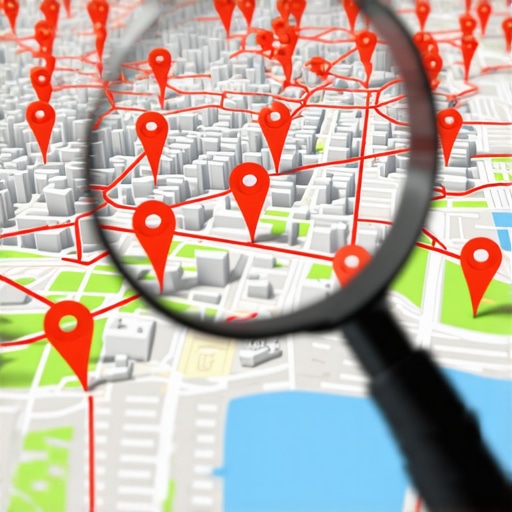
Local search rankings are primarily dictated by the physical distance between the searcher and the business center point combined with the prominence of the business entity. As the user moves, the map pack reshuffles based on proximity signals that calculate travel time and spatial relevance in real-time. This is the physics of the local algorithm. You cannot fight distance with keywords. You can only fight it with prominence. If you want to expand that reach, you should look into how to grow your map pack radius without opening new offices through legitimate local authority signals. Most people think they need more backlinks. In reality, they need better local justifications. These are the small snippets of text that say ‘Their website mentions [service]’ or ‘A review mentions [service]’. These justifications are the reason why your plumbing business disappears from local results after 5 pm if your hours or service area settings are not perfectly tuned.
Local Authority Reading List
- The Forensic Audit for Manual Recovery
- How to Stop Google from Filtering Your Listing
- The Essential Map Pack Toolkit
- Fixing Signal Errors for Growth
- The Exact Evidence Google Wants for Reinstatement
Fake reviews and the forensic audit
Fake reviews trigger manual actions when the account history, IP address, and behavioral patterns of the reviewer do not match legitimate customer movements. Google tracks the GPS history of reviewers, and if a person leaves a review for a plumber in New York but their phone has been in Florida for three weeks, the review is flagged as spam. This is why seo services to fix fake reviews issues are so vital for businesses that have been targeted by negative SEO attacks. I once worked with a cafe owner who had twenty 1-star reviews hit their profile in sixty minutes. We had to prove the patterns. We looked at the lack of ‘Check-in’ signals. We looked at the timing. If you are buying reviews, stop. It is the fastest way to get a permanent ban. Instead, you should learn how to get authentic customer reviews fast without triggering a spam filter by using real-world interactions at your place of business. This creates a high-trust loop that the algorithm loves.
“Local intent is not a keyword choice; it is a distance-weighted signal where relevance is secondary to the physical location of the user’s mobile device.” – Map Search Fundamental
Cleaning up the mess left by AI content
AI generated content triggers penalties when it fails to provide unique local information or exhibits the repetitive linguistic markers typical of large language models. Google rewards information gain, meaning your content must provide new, specific details about your local service area that cannot be found on a thousand other generic websites. Many businesses used AI to scale their location pages and now they are paying the price. This is where seo services to clean up ai generated spam content penalties come into play. You need to strip away the fluff. You need to add ‘Street-Level’ detail. Mention the local park. Mention the specific intersection where you did a job. If your content sounds like a textbook, you are failing. You must be removing ai generated spam to protect your search visibility before the next core update wipes you out. This is a primary component of cleaning up ai spam content before your local ranking drops and ruins your lead flow.
The 2026 shift toward image metadata
Future local search rankings will rely heavily on the visual proof provided by user-uploaded images and the EXIF metadata that confirms the location of the photo. While standard reviews still matter, 2026 data indicates that customer photos taken on-site are 30 percent more effective for winning AI Overview citations than text-only testimonials. This is a massive shift. It moves the needle from ‘what people say’ to ‘what people prove’. You should be encouraging customers to take photos of the finished project while they are still at your location. This creates a geospatial anchor that is impossible to fake. It is one of the 5 specific moves that actually push your profile into the top 3 without spending a fortune on ads. This strategy is also part of the simple visual tweak that stops map users from scrolling past your business because it builds immediate visual trust.
Debugging ranking drops with clean backlinks
Ranking drops often occur when the backlink profile of a local business becomes cluttered with generic, non-local links that provide no geographic relevance to the entity. A local business does not need a link from a high-authority tech blog in Silicon Valley; it needs a link from the local little league team or the neighborhood chamber of commerce. If you have been buying cheap link packages, you likely need services to clean up spammy backlinks to restore your reputation. Focus on why local relevance beats high authority links for map rankings in every single test we run. You need to be stop buying generic links why niche citations are the only listings that move the needle for your specific industry. One link from a local news site is worth a hundred links from a domain with high DA but zero local context. This is how you debug ranking drops with clean backlinks and content that actually reflects your community standing.
The engagement gap and response times
High impressions without calls usually indicate a failure in the engagement signals that Google uses to determine if a business is currently active and reliable. If you are getting views but no clicks, your profile is likely missing the ‘Response Time’ signal that has become a major ranking factor for 24-hour services. Google knows how fast you answer messages. They know if you ignore reviews. This is how response time became a critical signal for 24-hour service rankings and why your competitors might be beating you with fewer reviews. You must bridge the engagement move most local businesses completely miss by interacting with every single signal the user sends. If you are turning impressions into customers the engagement move most local businesses completely miss, you are essentially training the algorithm to show your profile more often. It is a feedback loop of trust and activity.
The specific schema tags for service areas
Structured data must include precise GeoShape and ServiceArea coordinates to help search engines understand the exact boundaries of your business operations. Without these tags, Google has to guess where you work, which often leads to your profile being hidden in high-value neighboring suburbs. Using the specific schema tags that help google trust your service area is the difference between ranking in one zip code and ranking in ten. It is about how to build service area pages that actually stick in high competition suburbs without triggering a spam flag for ‘keyword stuffing’ your location names. This is especially important for why service area businesses fail to show up in neighboring towns despite having a valid license to work there. You are essentially providing a digital map to the AI that says ‘I am a trusted entity in this specific polygon’.
“The prominence of a local entity is calculated through a combination of brand mentions, proximity to the searcher, and the velocity of verified user interactions.” – Local Intelligence Whitepaper
The toolkit for long term map dominance
Dominating the map pack requires a dedicated suite of tools that track local grid rankings and monitor citation consistency across the entire ecosystem. You cannot manage a local presence using only standard SEO tools because they do not account for the hyper-local variance of the 3-pack. You need the exact toolkit needed for local map pack growth, which includes geo-grid trackers and audit software. This allows you to see the simple local audit that reveals exactly where your competitors are losing traffic and move into that space. Whether you are improving your map ranking with a targeted tool strategy or manually checking your NAP consistency, the goal is total data clarity. Use 3 essential tools for auditing map rankings without an enterprise budget to stay competitive without overspending. This is how you build a gmb ranking toolkit for small business owners that actually produces a return on investment.