
3 Essential Tools for Auditing Map Rankings Without an Enterprise Budget
3 Essential Tools for Auditing Map Rankings Without an Enterprise Budget
As a Local SEO Consultant and Google Business Profile Product Expert, I spend my days looking at the “behind-the-scenes” mechanics of how local businesses appear – or disappear – on Google Maps. One of the most frequent frustrations I hear from business owners is what I call the “Proximity Trap.” You sit at your desk, search for your services, and see your business sitting proudly at #1. You assume your google business profile seo is firing on all cylinders. But then, you drive two miles down the road to a coffee shop, run the same search, and you’re nowhere to be found. You’ve vanished from the Local Pack.
This “Audit Gap” is where most small businesses lose their competitive edge. Large franchises and enterprise-level corporations have the luxury of thousand-dollar monthly budgets for sophisticated software that tracks every micro-movement in the SERPs (Search Engine Results Pages). However, the small business owner or the independent agency often feels priced out of these insights. This is a dangerous position to be in, considering that 46% of all Google searches have local intent (according to the US Chamber of Commerce). If you aren’t auditing your presence because of budget constraints, you are essentially flying blind while your competitors use radar.
To survive in a landscape where proximity, relevance, and prominence dictate who gets the lead, you need a “Signal Audit.” You don’t need a five-figure software suite; you need the right data at the right time. In this guide, I’m going to break down the three essential tools you need to Why Your Map Pack Ranking Stalled and the 5 Specific Fixes to Get It Moving, ensuring you can compete with the giants without the enterprise price tag.
The Proximity Trap and the Need for Spatial Data
The biggest mistake in local search is treating your ranking as a single, static number. If a software tool tells you that you “rank #2,” it is lying to you. In reality, you rank #2 at a specific latitude and longitude. Move fifty feet to the left, and you might be #5. This is the essence of google business profile seo: it is geographic, not just keyword-based.
Enterprise SEOs understand this, which is why they focus on “Signal Audits.” A signal audit looks at how Google perceives your business across a wide area. Without this data, you might waste months trying to rank google business profile for keywords you already “own” at your office, while remaining invisible to the neighborhood that actually drives your revenue. To bridge this gap, we need tools that visualize the map, not just a spreadsheet of numbers.
Tool #1: Visual Grid Tracking for Spatial Awareness
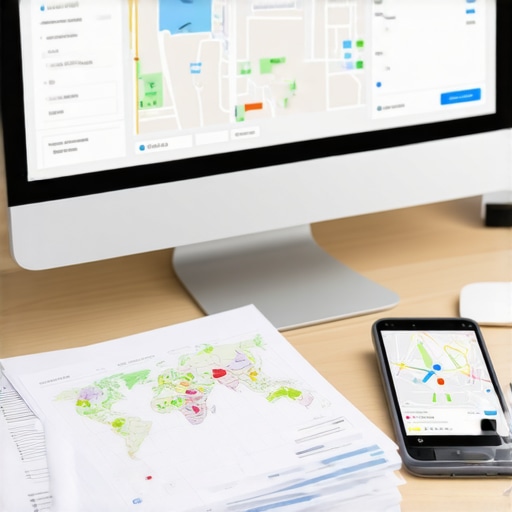
If you want to truly understand your local footprint, you must move beyond traditional rank trackers. Standard trackers usually ping a search from a single data center or a general zip code. This provides a distorted view of reality. To get a true audit, you need a grid-based heat map. For this, I recommend SEO Viper Tools as the premier google maps rank tracker for those who need enterprise-level data on a realistic budget.
Why Grid Audits are Non-Negotiable
A grid audit places a “virtual searcher” at specific intervals (e.g., every 500 meters) across your city. It then records your ranking at each point. This creates a visual heat map where green dots represent Top 3 rankings and red dots represent the “dead zones” where you are invisible. When you approach google business profile seo through a spatial lens, you stop guessing and start seeing the “ranking radius.”
For example, you might find that your rankings are strong to the North and East of your location but drop off significantly to the West. This data allows you to ask the right questions: Is there a strong competitor to the West? Is my NAP data inconsistent in that specific suburb? Is my “service area” defined incorrectly in my profile? This level of insight is crucial to How to stop proximity shrink with 2026 maps scaling systems.
Maximizing Your Ranking Radius
Using a tool like SEO Viper allows you to identify where your “signal” is weakening. If you see your ranking drop from #3 to #12 just three miles away, you know you have a prominence issue. You don’t need more keywords; you need more local authority signals in that specific geographic area. By visualizing the data, you can prove to yourself – or your clients – exactly where the growth opportunities lie. This is the most cost-effective way to rank higher on google maps because it prevents you from spending resources on areas where you are already dominant.
Tool #2: The Citation & NAP Consistency Scanner
The second pillar of any successful audit is “Trust.” Google’s algorithm needs to be absolutely certain that your business exists where you say it does and does what you say it does. This certainty is built through citations – mentions of your Name, Address, and Phone number (NAP) across the web. While Yext is the well-known giant in this space, it can be prohibitively expensive for a single-location business.
To audit your trust signals, you need affordable local seo tools that can scan the ecosystem for fragmented data. Tools like BrightLocal or Whitespark offer “audit-only” options that are perfect for budget-conscious businesses. These tools search through hundreds of directories, from Yelp and Yellow Pages to niche industry sites, to find discrepancies.
The Technical Danger of Inconsistent NAP
Why does an old phone number on a forgotten directory matter? Because Google is a data aggregator. If it finds three different addresses for your “google business profile optimization” efforts, it loses confidence. When Google is “confused” by conflicting data, it hedges its bets by ranking a competitor with cleaner data higher. It’s not that the competitor is better; it’s that the competitor is more “verifiable.”
A thorough citation audit will reveal:
- Duplicate listings (which split your ranking power).
- Incorrect phone numbers or old suite numbers.
- Missing opportunities on high-authority local directories.
Cleaning up these errors is often the fastest way to How to Fix the Subtle NAP Errors Costing Your Business Local Leads. It’s the “low-hanging fruit” of local SEO.
Using Affordable Local SEO Ranking Tools
Instead of paying for a monthly subscription to “sync” your data (which often reverts the moment you stop paying), use these local seo ranking tools to generate a one-time report. This allows you to manually fix the most important 10-15 citations. This “manual-first” approach saves thousands of dollars over the life of a business while providing the same algorithmic boost as the enterprise suites.
Tool #3: Competitor Signal Analysis
You cannot rank in a vacuum. To reach the Top 3, you have to displace someone who is already there. This requires a google business profile audit tool that doesn’t just look at you, but looks “under the hood” of your competitors. You need to understand why Google has granted them the “Prominence” you are currently lacking.
When auditing competitors, we focus on three main areas:
- Primary and Secondary Categories: Often, a competitor is outranking you simply because they’ve chosen a more accurate primary category that matches the user’s intent.
- Review Velocity and Sentiment: It’s not just about the total number of reviews; it’s about how many they are getting per month and what keywords are appearing in those reviews.
- Unstructured Mentions: These are mentions of a business on local blogs, news sites, or community forums that don’t follow a standard directory format.
The Three Pillars: Proximity, Relevance, and Prominence
Google’s local algorithm is built on these three pillars. While you can’t easily change your Proximity (where your office is located), you can absolutely influence Relevance (through category selection and on-page SEO) and Prominence (through reviews and backlinks). A competitor audit reveals which of these pillars your rival is leaning on. If they have fewer reviews than you but rank higher, they likely have higher relevance through better category optimization or a stronger website backlink profile.
You can Reverse-Engineering the Competition: How to See Exactly Which Signals Are Driving Their Map Rank by using a google business profile audit tool to scrape this data. By identifying that the #1 ranker is using “Personal Injury Attorney” as their primary category while you are using “Law Firm,” you can make a simple change that yields massive results. This is the “Product Expert” way of auditing: looking for the subtle levers that move the needle.
The 30-Minute Audit Workflow
Now that you know the tools, how do you use them effectively without spending all day in front of a screen? Following a structured workflow is the key to maintaining your google business profile seo without it becoming a full-time job. Here is my recommended “Budget Power Audit”:
- Step 1: Run a Grid Search (10 Minutes). Use SEO Viper to run a 7×7 or 9×9 grid around your location for your top 3 keywords. Identify your “dead zones.” If you see a wall of red starting just a mile away, you know you have a prominence problem.
- Step 2: Scan for NAP Errors (10 Minutes). Use a citation scanner to find the top 10 most “broken” directory listings. Focus on the big players: Bing, Apple Maps, Yelp, and your local Chamber of Commerce.
- Step 3: Compare Primary Categories (10 Minutes). Look at the top 3 businesses in your “dead zones.” Use a browser extension or an audit tool to see their primary and secondary categories. If they differ from yours, test a change.
This simple process, which I detail further in The 10-Minute Signal Audit That Reveals Why Your Google Map Presence Stalled, ensures that you are consistently feeding Google the signals it wants to see.
The Future: 2026 and AI Search Signals
As we move toward 2026, the landscape of local search is shifting. We are seeing the rise of “Signal Loops,” where AI-driven search engines like Perplexity and ChatGPT (SearchGPT) rely on the same data found in these audits to provide recommendations. These AI models aren’t just looking at your Google profile; they are “crawling” the entire local ecosystem to see if you are a trusted entity.
If your NAP data is messy or your geographic “footprint” is non-existent in grid trackers, these AI models will likely overlook you. Auditing your map rankings is no longer just about staying in the Local Pack; it’s about ensuring your business exists in the “Answer Engine” era. By using these three essential tools today, you are future-proofing your business against the next decade of search evolution.
Conclusion: Strategy Over Software
Tools are only as good as the strategy behind them. You don’t need to spend $500 a month on an enterprise SEO dashboard to see results. By focusing on spatial awareness with a google maps rank tracker, ensuring data integrity with citation scanners, and reverse-engineering your competition, you can achieve a level of google business profile seo that rivals any national franchise.
The difference between the businesses that thrive and those that struggle isn’t the size of their budget – it’s the accuracy of their data. Stop guessing why your rankings have stalled. Start measuring, start auditing, and start winning. If you’re ready to see exactly where you stand on the map, I highly recommend you visit SEO Viper Tools and run your first grid audit today. The data is there; you just have to look at it.